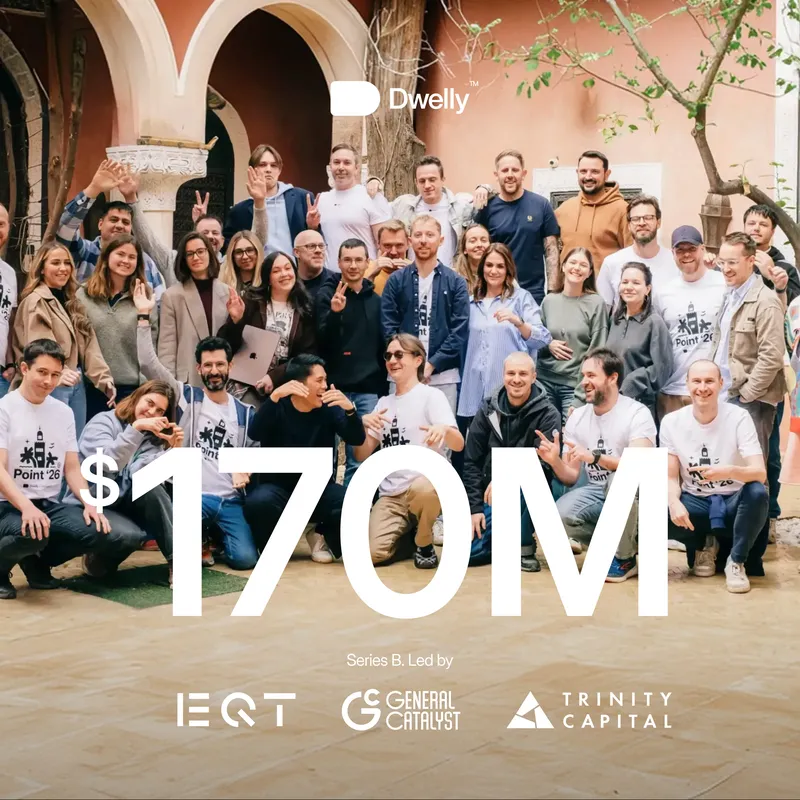
Dwelly's Round Was Never About Dwelly
Dwelly raised $170M to build what it calls an "AI operating system" for lettings. Most coverage framed it as another proptech unicorn story. That framing misses the signal.
A venture firm just bet nine figures on a specific premise: real estate firms don't need better software. They need an operating layer that coordinates the software, data, and human workflow they already run.
That premise shifts the calculus for every brokerage, from the mid-size regional shop to the national franchise. If Dwelly's thesis holds, the path to AI-native operations doesn't require a $170M war chest. It requires the right deployment architecture.
What Dwelly Built vs. What the Category Requires
Dwelly's platform targets the lettings lifecycle: tenant inquiry, viewing scheduling, referencing, tenancy agreements, ongoing property management. The "AI operating system" label matters because this isn't a CRM with chat bolted on. It's a coordination layer.
The distinction is structural. A traditional property management system stores data and automates rules. An AI operating system observes the full workflow, reasons about what should happen next, and executes against connected tools.
That architecture difference is why HumaticAI has deployed similar layers across industries, including real estate, since before the category had a name.
The Third Path Between Build and Buy
Funding news like Dwelly's pushes brokerages toward two apparent options: build proprietary AI (infeasible for all but the largest firms) or wait to be acquired by a platform player.
There's a third path. Sotheby's International Realty Cyprus took it, and the pattern is reproducible for any brokerage with an existing tech stack.
What the Sotheby's Cyprus Deployment Showed
Sotheby's International Realty Cyprus deployed HumaticAI's platform across several dozen agents. The goal wasn't replacing systems. It was putting an AI layer on top that could reason across listing data, client communications, and market signals.
The adoption curve was the tell. When agents see value in the first hour, they don't need mandates. They pull the tool into their workflow themselves.
That's what an AI operating system for real estate looks like in practice: not a new system of record, but a layer that makes the existing stack smarter.
Three Capabilities That Separate an Operating System from a CRM
Context persistence. A CRM stores contact records. An AI operating system maintains durable context about every client interaction, property detail, and preference signal across months or years. HumaticAI's Mira layer handles this through memory connectors that preserve peer context between sessions.
Cross-tool orchestration. When a lead arrives from a portal, someone must qualify them, update the CRM, schedule a viewing, and prepare comparable market data. A CRM automates individual steps. An operating system coordinates the whole sequence across tools.
Live data awareness. Property listings change daily. Price adjustments, status changes, and market shifts all affect client conversations. An operating system with live extraction capabilities, like HumaticAI Rover's browser capture stack, keeps the AI layer current with what's actually on the page.
None of this requires replacing your property management system, your CRM, or your marketing stack. It requires a deployment platform that sits above them.
The Skepticism Objection, Answered Directly
Most brokerage leaders have been burned by proptech promises. They've watched "AI-powered" CRMs fail because the AI was a rules engine with better marketing.
That skepticism is warranted. It's also why the deployment model matters more than the demo.
An AI operating system only works if it connects to your actual tools. That's where Model Context Protocol connectors come in. HumaticAI's CRM MCP lets the AI layer read from and write to your existing CRM and tooling through standardized connectors, rather than requiring a rip-and-replace migration.
The practical test: can you deploy alongside your current stack in days, not quarters? If not, you're not buying an operating system. You're buying a migration project.
When an AI Operating System Is the Wrong Answer
Not every brokerage should pursue this. Be clear-eyed about the conditions.
Paper-based operations. Digitize first. An AI layer over chaos produces faster chaos.
Fewer than a handful of agents. Coordination gains may not justify the investment yet. Focus on volume first.
Leadership won't engage with deployment. Skip it. Adoption fails when the principal treats AI enablement as an IT project rather than an operational strategy. The Sotheby's Cyprus case worked because leadership drove it.
These aren't disqualifiers for every firm. They're honest filters that save money and frustration.
The 18-Month Window
Dwelly's round doesn't just validate the category. It accelerates the timeline. When venture capital flows into a category, talent follows, and so does enterprise buyer attention.
The practical consequence for brokerages: the window to build AI-native operations advantage is open now. Not because Dwelly will disrupt you specifically, but because firms that deploy AI operating layers in 2025 and 2026 will compound advantages in lead response time, client service quality, and operational efficiency that laggards will struggle to close.
The real estate case study from Cyprus shows the pattern. The enterprise AI platform architecture makes it reproducible.
Start with One Workflow
If you're convinced enough to explore, start narrow. Pick one workflow where manual coordination hurts most. For most brokerages, that's lead qualification and follow-up. The time between inquiry and first contact is where deals are won and lost.
An AI SDR for real estate can automate the qualification conversation while your agents focus on viewings and negotiations. That's a contained use case with measurable outcomes, not a bet-the-firm transformation.
Run it for 60 days. Measure response time, qualification accuracy, and agent feedback. Then decide whether to expand the operating layer to listings management, client communications, or market analysis.
The $170M question isn't whether AI operating systems will reshape real estate. It's whether your firm will be running one or competing against one. What's your first workflow to test?